Dietary fiber is one of the fundamental components of plant-based foods and an essential part of a varied and balanced diet. Despite its importance, most people do not consume the recommended daily amount. Modern lifestyles, characterized by a high intake of processed foods, often result in fiber consumption that falls below the levels recommended by nutrition experts.
Although fiber is often referred to as a single substance, it is actually a diverse group of plant compounds with different properties. Some types dissolve in water and form a gel, others remain insoluble, while certain fibers serve as a natural source of nutrients for beneficial gut microorganisms. For this reason, not all types of dietary fiber should be considered the same.
In recent years, dietary fiber has become a major focus of scientific research, particularly in relation to the gut microbiome. Researchers are investigating how different types of fiber influence the environment of the large intestine and the role they play in fermentation processes.
In this article, we explain what dietary fiber is, how it is classified, the different types of fiber, and what distinguishes them from one another. We also explore its journey through the digestive system, the gut microbiome, short-chain fatty acids (SCFAs), natural dietary sources of fiber, and recommendations for daily fiber intake.
The aim of this article is to provide a clear, evidence-based overview of dietary fiber that will help you better understand this important area of modern nutrition.
Dietary fiber is a natural component of plant-based foods and consists of the indigestible parts of the diet. Unlike most carbohydrates, it cannot be broken down by human digestive enzymes and therefore passes through the digestive tract until it reaches the large intestine.
The term “dietary fiber” does not refer to a single substance but to a group of compounds with different chemical structures and properties. Individual types of fiber vary in characteristics such as water solubility, fermentability, viscosity, and prebiotic properties, all of which influence their behavior within the digestive system.
Most dietary fiber consists of complex carbohydrates known as non-starch polysaccharides. However, dietary fiber also includes other compounds, such as lignin.

Dietary fiber is not a single substance but a group of compounds with different properties. For this reason, experts classify it according to several criteria.
These classification systems complement one another. A single type of fiber may possess several of these characteristics at the same time. In the following section, we introduce the best-known types of dietary fiber and explain their key properties.
The diversity of dietary fiber is precisely why a varied diet rich in plant-based foods is the best way to ensure an adequate natural intake. In the next section, we take a closer look at the different types of dietary fiber and how they differ from one another.
There are many different types of dietary fiber, each varying in origin, chemical structure, and functional properties. Some occur naturally in cereals, while others are found in fruits, vegetables, legumes, or plant gums. Each type of dietary fiber has its own specific characteristics, meaning they should not be considered interchangeable.
The best-known types of dietary fiber include:
Although they all belong to the category of dietary fiber, their properties can differ significantly. The main differences lie in water solubility, fermentability, viscosity, and prebiotic properties.
The following table provides a simple comparison of the best-known types of dietary fiber.
| Type of Fiber | Solubility | Fermentability | Prebiotic Properties | Forms a Gel |
|---|---|---|---|---|
| Beta-glucans | Yes | Yes | Partially | ✓ |
| Psyllium | Mostly yes | Partially | No | ✓ |
| Inulin | Yes | Yes | Yes | ✗ |
| FOS | Yes | Yes | Yes | ✗ |
| GOS | Yes | Yes | Yes | ✗ |
| Acacia fiber | Yes | Yes (slower) | Yes | ✗ |
| Carrot fiber | Partially | Partially | Partially | ✗ |
| Resistant starch (RS2) | No | Yes | Yes | ✗ |
| Glucomannan | Yes | Yes | Partially | ✓ |
| Lignin | No | No | No | ✗ |
As you can see, different types of dietary fiber vary considerably. That is why it is beneficial to obtain fiber from a variety of natural dietary sources that complement one another. In the next section, we look at how dietary fiber moves through the digestive system and what happens to it from the moment it is consumed until it reaches the large intestine.
After food is consumed, dietary fiber begins its journey through the digestive system. Unlike most nutrients, however, it is not broken down by digestive enzymes and is not absorbed in the small intestine. This characteristic distinguishes it from most carbohydrates.
As dietary fiber passes through the digestive tract, different types behave in different ways. Some absorb water and form a gel-like structure, others remain largely unchanged, while certain types become a natural source of nutrients for gut microorganisms.
Most fermentable fibers reach the large intestine, where they are utilized by the bacteria that make up the gut microbiome. During this natural fermentation process, short-chain fatty acids (SCFAs) are produced, which we discuss in more detail in the following sections.
The Journey of Dietary Fiber Through the Digestive System
Mouth → Stomach → Small Intestine → Large Intestine → Fermentation → SCFAs
It is in the large intestine that dietary fiber plays its most important role. What happens next depends on the specific type of fiber and the composition of the gut microbiome.
The large intestine is home to billions of microorganisms that together form the gut microbiome. Every individual has a unique microbiome, influenced by factors such as diet, age, lifestyle, and the use of antibiotics.
Some types of dietary fiber serve as a natural source of nutrients for gut bacteria. These bacteria ferment the fiber and utilize it as part of their metabolism. This is one of the reasons why dietary fiber has become one of the most extensively studied components of modern nutrition.
In the next section, we look at the compounds that are naturally produced during fiber fermentation.
During the fermentation of certain types of dietary fiber, short-chain fatty acids (SCFAs) are produced. The best-known SCFAs are acetate, propionate, and butyrate.
These compounds are naturally formed in the large intestine through the activity of gut bacteria. Their production depends on both the type of dietary fiber consumed and the composition of the gut microbiome.
SCFAs are among the most intensively studied products of dietary fiber fermentation, and their role continues to be the subject of ongoing scientific research.
Dietary fiber is a natural part of a varied and balanced diet. Since different types of fiber have different properties, they should not all be attributed with the same effects.
Some fibers are known for their prebiotic properties, others form a gel, while some are naturally present in whole grains, fruits, vegetables, and legumes. Certain types of fiber, such as beta-glucans and glucomannan, also have specific authorized health claims under European Union legislation.
The best way to ensure an adequate fiber intake is to consume a varied diet rich in naturally plant-based foods.
The recommended daily intake of dietary fiber may vary slightly depending on age, sex, and nutritional guidelines. In general, adults are advised to consume approximately 25 to 35 grams of dietary fiber per day as part of a varied and balanced diet.
Despite these recommendations, most people consume less fiber than advised. The most common reason is a low intake of vegetables, fruits, legumes, and whole grains.
Adequate fiber intake can be achieved through a varied diet rich in natural plant-based foods.
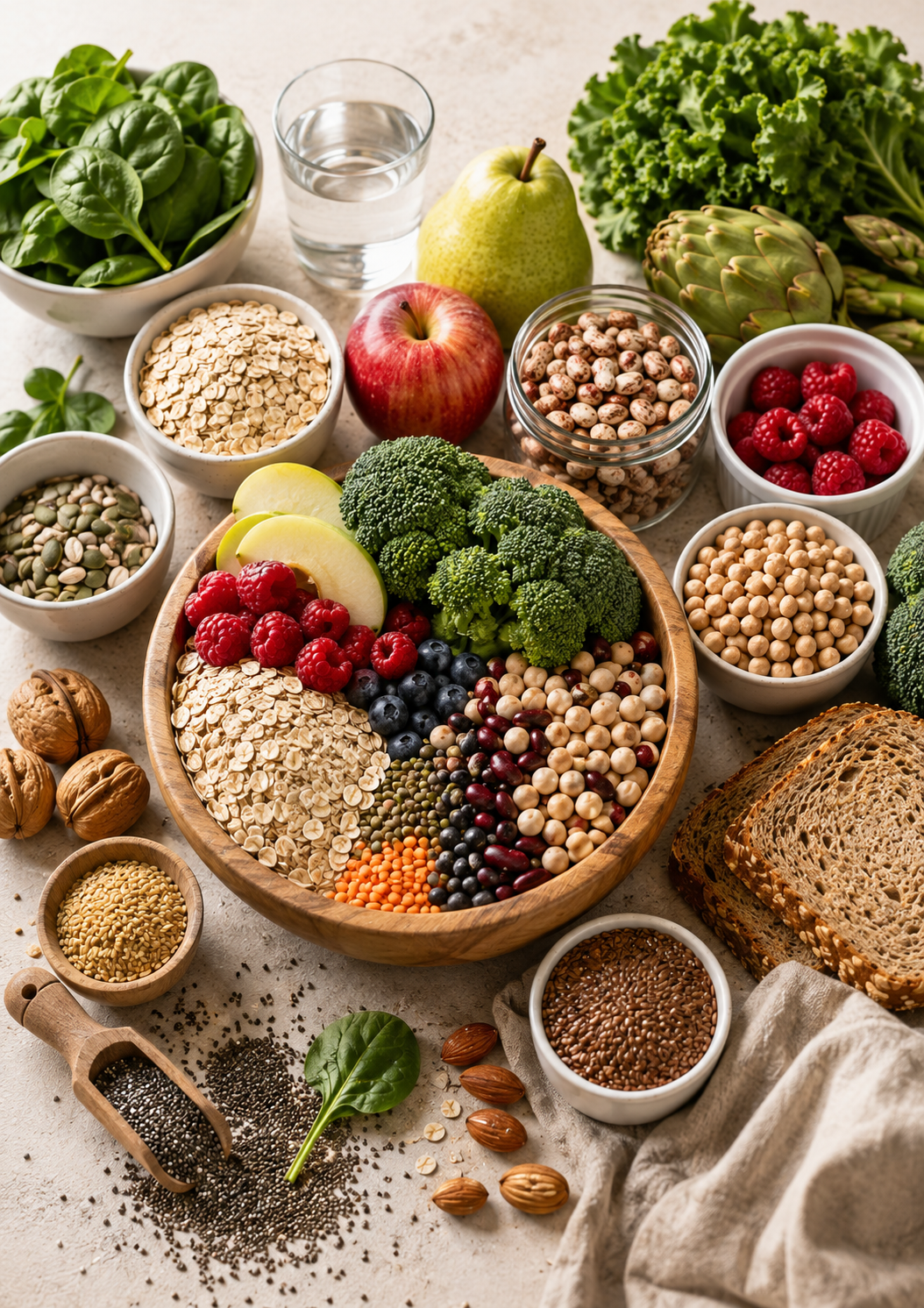
Dietary fiber occurs naturally in most plant-based foods. Since each food group contains different types of fiber, it is beneficial to include a variety of them in your diet.
The most important sources include:
A varied diet based on these foods provides a natural intake of different types of dietary fiber as well as many other essential nutrients.
If your current fiber intake is low, it is recommended to increase it gradually. Both your body and your gut microbiome need time to adapt to a higher intake of dietary fiber.
When increasing your fiber intake, it is advisable to:
Gradual dietary changes are generally more sustainable than sudden adjustments.
A varied and balanced diet should always be the primary source of dietary fiber. However, in some situations, food supplements containing dietary fiber can be a practical option.
When choosing a fiber supplement, it is worth considering the type of fiber used, the amount provided per serving, and the recommended directions for use. Since different types of dietary fiber vary considerably, there is no universal solution suitable for everyone.
There are many misconceptions surrounding dietary fiber. One of the most common is the belief that there is only one type of fiber or that all fibers work in the same way.
Another common misconception is that eating salads alone provides enough dietary fiber. In reality, the best approach is a varied diet containing a wide range of plant-based foods that naturally provide different types of dietary fiber.
Dietary fiber is an important part of a varied and balanced diet. Although it is often referred to as a single substance, it is actually a diverse group of compounds with different properties.
A varied diet based on vegetables, fruits, legumes, whole grains, nuts, and seeds provides a natural intake of different types of dietary fiber. If the recommended intake cannot be achieved through diet alone, high-quality fiber supplements may be a suitable addition.
Research into dietary fiber and the gut microbiome continues to evolve, providing new insights into their role in human nutrition. We hope this article has helped you better understand this topic and made it easier to choose suitable sources of dietary fiber as part of a healthy lifestyle.


