Resistant potato starch RS2 (Resistant Starch Type 2) is one of the most extensively studied forms of dietary fiber in the fields of nutrition, gastroenterology, and gut microbiome research. Unlike regular starch, it is not completely digested enzymatically in the small intestine, but to a significant extent passes into the large intestine, where it becomes a natural part of fermentation processes mediated by gut microorganisms.
In recent years, resistant starch has become a major focus of scientific research. This is not because of its energy value, but because of its unique physicochemical properties, digestion pathway, and interaction with the gut microbiome. A growing number of experimental and clinical studies are examining its fermentation, the production of short-chain fatty acids (SCFAs), changes in the composition of the gut microbiome, and other physiological processes related to digestive system function.
Although the term starch is often used to refer to a single nutrient, from a biological perspective it represents a heterogeneous group of polysaccharides whose properties can differ significantly. The botanical origin, the ratio of amylose to amylopectin, the spatial organization of starch granules, and the way the food is processed all play an important role. These factors determine the extent to which starch is accessible to digestive enzymes.
Resistant starch type RS2 is a naturally occurring form of resistant starch whose resistance to digestion is determined by the preserved native crystalline structure of the starch granules. This structure significantly limits access by pancreatic α-amylase, allowing a substantial portion of the starch to escape digestion in the small intestine and continue into the large intestine.
In its natural form, RS2 is found mainly in raw potatoes and green bananas. It is also currently available as highly purified resistant potato starch intended for use in functional foods, dietary supplements, and clinical research. According to available data, these forms contain more than 60% resistant starch and more than 63% total dietary fiber, while retaining their native structure without chemical modification.
The aim of this article is to provide a comprehensive overview of resistant potato starch RS2 from the perspective of its chemical structure, digestive physiology, fermentation in the large intestine, role in the gut microbiome, and current scientific knowledge. We will also explain why RS2 is considered one of the most important prebiotic components of modern nutrition.
Starch is the main storage polysaccharide in plants and one of the most important sources of carbohydrates in human nutrition. From a chemical perspective, it consists of two glucose polymers – amylose and amylopectin, whose relative proportions influence its physical properties as well as its digestibility.
In most foods, starch is hydrolyzed during digestion by salivary and pancreatic α-amylase into shorter carbohydrate chains and subsequently into glucose, which is absorbed in the small intestine. This process represents the basic mechanism by which starch is utilized as a source of energy.
Resistant potato starch RS2 differs from regular starch in that a significant portion of its molecular structure remains inaccessible to these enzymes. This is not due to chemical modification, but to the naturally preserved crystalline organization of the starch granules, which limits enzymatic access and slows hydrolysis.
As a result, a substantial portion of resistant starch passes through the small intestine without being completely broken down and reaches the large intestine. Here, it enters the natural fermentation processes of the gut microbiome, making its physiological role fundamentally different from that of regular starch.
From a nutritional perspective, RS2 represents a unique link between carbohydrates and dietary fiber. Although it is chemically still a starch, its physiological behavior resembles that of fermentable fiber. For this reason, resistant starch is currently the subject of intensive research focused on the gut microbiome, fermentation processes, and metabolic products generated during its utilization by gut bacteria.
The biological properties of resistant potato starch RS2 are closely linked to its molecular structure. This structure determines the extent to which starch is accessible to digestive enzymes and how it behaves as it passes through the digestive tract.
Unlike regular starch, which is largely hydrolyzed into glucose after consumption, resistant starch type RS2 retains its natural organization under physiological conditions. As a result, a significant portion of the starch granules remains inaccessible to enzymatic breakdown in the small intestine.
Molecular Composition of Starch
Regardless of its botanical origin, starch consists of two basic polysaccharides:
Amylose consists predominantly of linear chains of glucose molecules linked by α-(1→4) bonds. Compared with amylopectin, it forms more compact structures that are less accessible to digestive enzymes.
Amylopectin, on the other hand, has a highly branched structure containing both α-(1→4) and α-(1→6) bonds. Due to its greater degree of branching, its surface is more accessible to enzymes, which generally results in faster digestion.
The relative ratio of amylose to amylopectin is one of the main factors influencing the digestibility of different types of starch.
Starch Granules
In plants, starch is not stored in the form of individual molecules, but forms starch granules.
These granules are highly organized microscopic structures in which amylose and amylopectin molecules are arranged into regular layers.
The size, shape, and internal organization of granules vary depending on the botanical origin of the starch. Potato starch is characterized by relatively large granules with a distinctive oval to elliptical morphology.
The spatial arrangement of molecules within the granules significantly influences their resistance to enzymatic breakdown.
Crystalline Structure
One of the most important properties of resistant starch RS2 is its preserved native crystalline structure.
In crystalline regions, amylopectin molecules are arranged very tightly, creating stable areas with limited accessibility to digestive enzymes.
Pancreatic α-amylase is therefore unable to access all of the bonds within the starch granule, which significantly slows down or completely prevents its hydrolysis.
This property represents the fundamental mechanism behind the resistance of RS2 starch.
Effect of Food Processing
The structure of resistant starch is sensitive to food processing.
The most significant factor is temperature.
When heated in water, starch undergoes gelatinization. During this process, the original crystalline organization of the granules is disrupted, starch molecules absorb water, increase in volume, and gradually lose their natural structure.
As a result, starch becomes more accessible to digestive enzymes.
For this reason, resistant starch type RS2 is most commonly used without intensive heat treatment or added to foods after they have cooled, in order to preserve its characteristic physicochemical properties.
Why Is Structure So Important?
Unlike many nutrients, where chemical composition is the primary determining factor, resistant starch is governed by the combination of chemical composition and the spatial arrangement of molecules.
Two foods may contain similar amounts of starch, yet their behavior during digestion can be significantly different. Whether starch will be easily digestible or resistant depends not only on its amylose and amylopectin content, but also on the preservation of the natural structure of the starch granules.
It is precisely this unique combination of physical and chemical properties that makes resistant potato starch RS2 one of the most interesting forms of dietary fiber being studied in contemporary nutritional science.
The physiological behavior of resistant potato starch RS2 differs fundamentally from that of most starches consumed in the diet. While regular starch is gradually hydrolyzed into glucose during digestion and subsequently absorbed in the small intestine, resistant starch type RS2 passes through a significant portion of the digestive tract without being completely broken down enzymatically.
This property represents the fundamental prerequisite for its physiological effects and explains why RS2 is classified as a fermentable form of dietary fiber.
Starch digestion begins in the mouth
The digestion of starch begins immediately after food is consumed. During chewing, food mixes with saliva containing the enzyme α-amylase, which initiates the breakdown of starch chains into shorter oligosaccharides.
However, this process represents only the first stage of digestion and, given the short time food remains in the oral cavity, has only limited significance.
After entering the stomach, the activity of salivary α-amylase is gradually inhibited by the acidic environment of gastric juice.
The key role of the small intestine
The main part of starch digestion takes place in the small intestine.
After food enters the duodenum, pancreatic α-amylase is released and hydrolyzes starch into shorter carbohydrate chains. These are subsequently broken down by enzymes located on the surface of enterocytes into glucose, which is absorbed into the bloodstream.
With regular starch, this process is highly efficient and most of the consumed starch is completely utilized before reaching the end of the small intestine.
Why does RS2 resist digestion?
Resistant potato starch RS2 differs in that its starch granules remain only partially accessible to pancreatic α-amylase.
This is due to a combination of several factors:
As a result, a significant portion of the starch escapes enzymatic hydrolysis and continues further through the digestive tract.
It is important to emphasize that the term resistant does not mean completely indigestible. It refers to starch that resists digestion to a significantly greater extent than regular starch and reaches the large intestine in substantial amounts.
The large intestine – the site of fermentation
After passing through the small intestine, resistant starch RS2 enters the large intestine.
This is where the highest concentration of intestinal microorganisms is found, equipped with enzymes capable of breaking down indigestible polysaccharides.
Unlike human digestive enzymes, some bacteria can utilize resistant starch as an energy source. This process is known as microbial fermentation.
Fermentation takes place gradually, and its rate depends on several factors, including the composition of the gut microbiome, the amount of resistant starch consumed, and its physicochemical properties.
Fermentation products
A wide range of metabolites is produced during fermentation.
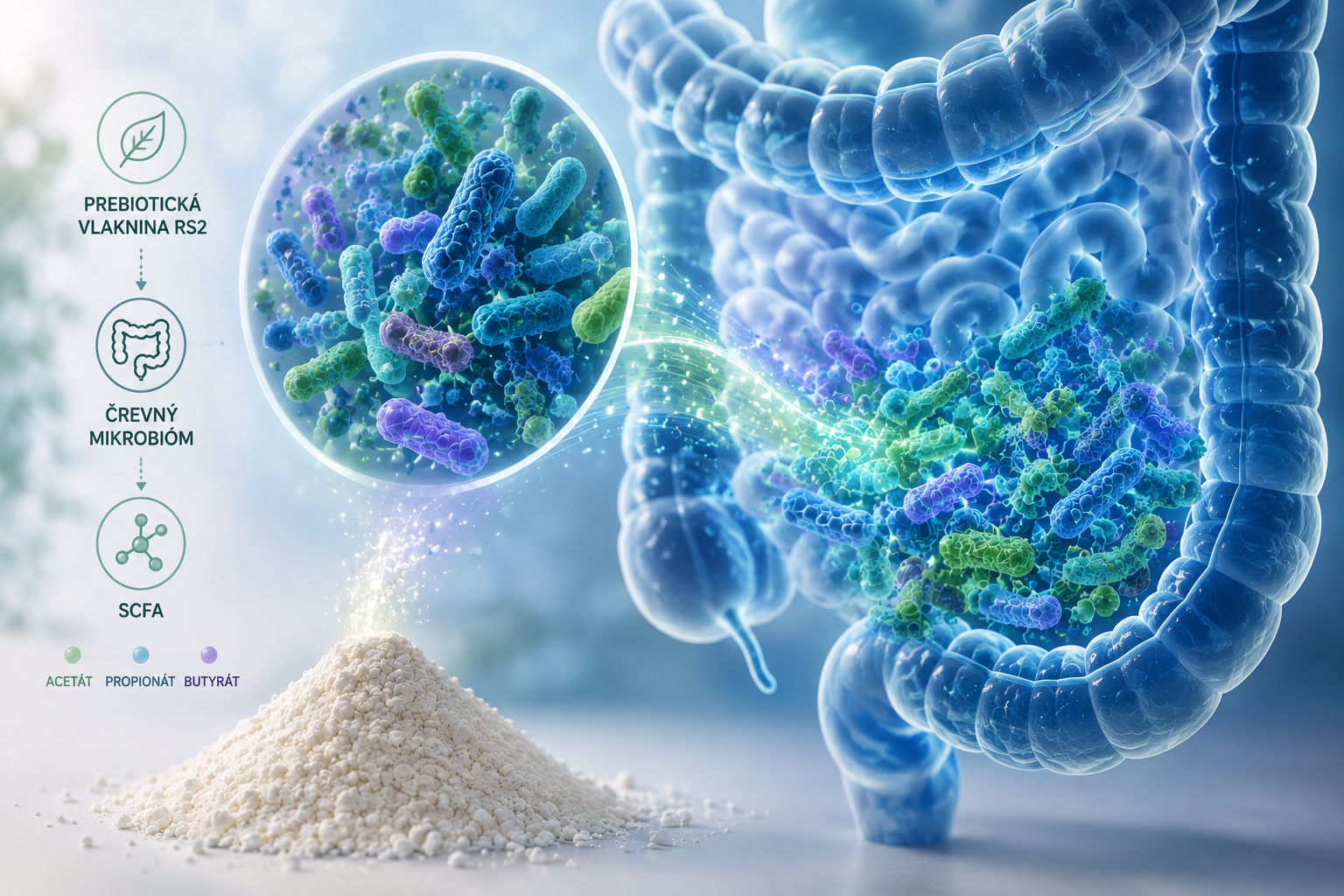
The most important group consists of Short-Chain Fatty Acids (SCFA), including:
Other metabolites are also produced and are the subject of intensive research, contributing to a better understanding of the relationship between nutrition, the gut microbiome, and the physiology of the digestive system.
Individual differences in fermentation
Resistant starch fermentation does not occur in exactly the same way in every person.
The individual composition of the gut microbiome plays an important role and is influenced by genetics, diet, lifestyle, age, and previous antibiotic use.
These differences may explain why individuals respond differently to the same intake of resistant starch. This area is among the most dynamically developing fields of research into personalized nutrition and the gut microbiome.
The gut microbiome is a complex community of microorganisms inhabiting the human gastrointestinal tract. It consists primarily of bacteria, but also archaea, viruses, and microscopic fungi, which together form a metabolically active ecosystem. The highest concentration of microorganisms is found in the large intestine, where optimal conditions exist for their growth, metabolic activity, and fermentation processes.
One of the fundamental functions of the gut microbiome is the metabolism of food components that the human body cannot completely break down using its own enzymes. These substances include various types of fermentable fiber, including resistant potato starch RS2.
Fermentation of resistant starch RS2
After passing through the small intestine, resistant potato starch RS2 enters the large intestine largely undigested. In this environment, it becomes a source of energy for microorganisms capable of producing enzymes that break down complex polysaccharides.
Fermentation is a natural biological process in which indigestible carbohydrates are enzymatically broken down by intestinal bacteria. Unlike regular starch, which is hydrolyzed and absorbed in the small intestine, resistant starch RS2 is metabolized only in the large intestine.
This property distinguishes RS2 from most starches consumed in the diet and is the reason why it is classified as a prebiotic component of the diet. According to the definition of the International Scientific Association for Probiotics and Prebiotics (ISAPP), a prebiotic is a substance that is selectively utilized by microorganisms of the gut microbiome and provides a health benefit. Documentation on resistant potato starch RS2 states that it meets this definition.
Microbial diversity
The gut microbiome consists of hundreds of bacterial species that differ in their metabolic activity and ability to utilize individual food components.
Resistant starch RS2 is not fermented by all bacteria in the same way. Its utilization depends on the presence of microorganisms equipped with specific enzymes capable of breaking down starch polysaccharides.
This individual variability is one of the reasons why the composition of the gut microbiome is considered an important factor influencing the course of resistant starch fermentation.
Clinical studies evaluating resistant potato starch RS2 have also examined, among other things, the abundance of bacteria of the genera Bifidobacterium and Akkermansia, which are among the most frequently studied microorganisms in the field of prebiotic nutrition.
Fermentation as a natural process
Fermentation of resistant starch is not a side effect of digestion, but a natural part of the metabolic activity of the gut microbiome.
During fermentation, several metabolites are produced, the most important group being Short-Chain Fatty Acids (SCFA). Their production is considered a characteristic feature of fiber fermentation in the large intestine and represents one of the most intensively studied areas of current nutritional science.
The following chapter will focus on short-chain fatty acids, explaining in greater detail how they are produced, their individual types, and their significance in the physiology of the intestinal environment.
Fermentation of resistant potato starch RS2 by the gut microbiome leads to the formation of several metabolites. The most important group consists of short-chain fatty acids (Short-Chain Fatty Acids – SCFA), which are natural products of bacterial metabolism of indigestible carbohydrates.
SCFA are produced primarily in the proximal parts of the large intestine during the fermentation of fiber and resistant starch. Their amount and relative proportions depend on several factors, including the type of fiber consumed, the composition of the gut microbiome, the rate of fermentation, and the availability of fermentable carbohydrates.
Quantitatively, approximately 95% of all short-chain fatty acids consist of three compounds:
Each of these is produced through different metabolic pathways and by different groups of intestinal microorganisms.
Acetate
Acetate is the most abundant short-chain fatty acid produced during fiber fermentation.
It is produced by a wide range of intestinal bacteria and represents the end product of several bacterial metabolic pathways. After being produced, it is partly utilized by the microorganisms themselves, while the remaining portion is absorbed through the intestinal wall into the portal circulation.
Due to its high abundance, acetate is among the most frequently analyzed metabolites in gut microbiome research.
Propionate
Propionate is produced through the fermentation of certain types of fiber by specific groups of bacteria.
After absorption, it is transported primarily to the liver, where it enters further metabolic processes.
In clinical and experimental studies, propionate is regularly evaluated together with acetate and butyrate as part of the profile of fermentation metabolites.
Butyrate
Butyrate is one of the most important short-chain fatty acids produced in the large intestine.
It is formed through the fermentation of resistant starch and other fermentable types of fiber by specialized groups of bacteria.
From a microbiological perspective, it is among the most intensively studied products of intestinal fermentation and is regularly evaluated in research on resistant starch, the gut microbiome, and fermentation processes.
The dynamic nature of fermentation
SCFA production is not constant. It varies depending on:
Different types of fiber differ in their rate of fermentation and the profile of metabolites produced. Resistant potato starch RS2 is among the types of fiber that are fermented gradually, which also influences the course of short-chain fatty acid production.
SCFA as an indicator of fermentation activity
In gut microbiome research, SCFA are among the most frequently monitored metabolites. Their concentration is used as one of the indicators of the fermentation activity of intestinal microorganisms when evaluating different types of fiber, including resistant starch.
For this reason, analyses of short-chain fatty acids are a common part of both experimental and clinical studies focusing on fermentable polysaccharides and prebiotic nutrition.
The term prebiotic is one of the fundamental concepts in modern nutrition and gut microbiome research. Its meaning has been refined over the years alongside the development of knowledge about intestinal microorganisms and their metabolic functions.
The currently most widely used definition was published by the International Scientific Association for Probiotics and Prebiotics (ISAPP), according to which a prebiotic is:
“A substance that is selectively utilized by host microorganisms and confers a health benefit.”
This definition emphasizes two fundamental characteristics of prebiotics:
Why is RS2 classified as a prebiotic?
Resistant potato starch RS2 meets the basic condition of a prebiotic by resisting digestion in the small intestine and reaching the large intestine, where it is fermented by selected intestinal microorganisms.
During fermentation, it is gradually broken down and metabolites characteristic of bacterial fiber fermentation are produced, including short-chain fatty acids (SCFA).
This ability distinguishes RS2 from regular starch, which is largely broken down and absorbed before reaching the large intestine.
Fermentation is a selective process
The gut microbiome consists of an extraordinarily diverse community of microorganisms with different metabolic capabilities.
Not all bacteria are capable of fermenting resistant starch RS2. Only microorganisms equipped with the appropriate enzymes for breaking down complex polysaccharides possess this ability.
For this reason, when evaluating prebiotics, attention is paid not only to the intensity of fermentation but also to which groups of microorganisms are involved.
RS2 and the gut microbiome
Clinical studies with resistant potato starch RS2 have evaluated not only fermentation but also changes in the composition of the gut microbiome.
The most frequently monitored groups were bacteria of the genera Bifidobacterium and Akkermansia, which are important subjects of research in the field of prebiotics and the gut microbiome.
However, interpreting changes in the abundance of individual microorganisms requires caution. The composition of the gut microbiome is highly individual and is influenced by numerous factors, including age, diet, health status, medication use, and lifestyle.
Prebiotics as part of a varied diet
Resistant potato starch RS2 is one of several substances referred to as prebiotics.
This group also includes other fermentable food components, such as:
Individual prebiotics differ in their chemical structure, fermentation rate, and the spectrum of microorganisms capable of utilizing them.
This diversity of fermentable fiber is one of the characteristic features of a varied and balanced diet.
Resistant potato starch RS2 is a prebiotic component of food because it resists digestion in the small intestine and is fermented by selected microorganisms in the large intestine. During fermentation, metabolites characteristic of the bacterial breakdown of fiber are produced, including short-chain fatty acids.
The ability of RS2 to participate in these fermentation processes is one of the main reasons why it is the subject of intensive research into the gut microbiome and modern nutrition.
Resistant potato starch RS2 is among the best-studied forms of resistant starch. Clinical research focuses primarily on its fermentation in the large intestine, interaction with the gut microbiome, and changes in biological markers associated with digestive system function and metabolism.
Available publications include randomized, double-blind, placebo-controlled clinical trials, as well as subsequent secondary analyses of the collected data. Most published studies are based on the same clinical trial, with individual articles evaluating different laboratory and clinical parameters.
Characteristics of the published studies
The published clinical program includes a total of six peer-reviewed scientific publications investigating the effects of resistant potato starch RS2 in healthy adult volunteers.
The main clinical study was designed as:
Participants received 3.5 g or 7 g of resistant potato starch RS2 daily for 4 weeks, while changes in selected clinical and laboratory parameters were evaluated throughout the study.
Areas of research
The published studies focused on several main areas:
Overview of published scientific studies
The studies published to date have focused primarily on the following areas:
Interpretation of the results
The individual publications evaluated different biological markers and clinical indicators. Their results should be interpreted in the context of the study design, characteristics of the population studied, duration of the intervention, and analytical methods used.
The body of published research represents a significant contribution to our understanding of the physiology of resistant potato starch RS2. At the same time, it highlights the need for further independent clinical studies to verify the findings in different population groups and over longer periods of observation.
Although resistant potato starch RS2 is the subject of intensive scientific research, its use is not limited to laboratory or clinical settings. Thanks to its physicochemical properties, it can be part of a regular diet and is used in functional foods and dietary supplements.
One of its advantages is its neutral taste, light color, and good dispersibility, which means that it does not significantly alter the sensory properties of prepared foods and beverages.
Ways to incorporate it into the diet
Resistant potato starch RS2 can be added to various cold or lukewarm foods, for example:
When using it, the manufacturer’s recommendations should be followed, particularly regarding the maximum processing temperature. Intensive heat treatment may disrupt the native crystalline structure of the starch and alter its physical properties.
Gradual increase in intake
As with other fermentable types of fiber, it is recommended to increase resistant starch intake gradually.
A sudden increase in fermentable fiber intake may be associated with temporary digestive symptoms in some individuals, such as a feeling of fullness, increased gas production, or bloating. These symptoms are related to the adaptation of the gut microbiome to a higher intake of fermentable carbohydrates.
When increasing fiber intake, it is also advisable to ensure adequate fluid intake and overall dietary variety.
Resistant starch RS2 should be viewed as part of an overall varied and balanced diet, not as a replacement for natural sources of fiber such as vegetables, fruit, legumes, or whole grains.
Resistant potato starch RS2 is a natural form of resistant starch that differs from regular starch through its ability to resist enzymatic digestion in the small intestine. Thanks to the preserved native structure of its starch granules, a significant portion reaches the large intestine, where it participates in the natural fermentation processes of the gut microbiome.
In this article, we have presented its chemical and physicochemical properties, digestion mechanism, role of the gut microbiome, formation of short-chain fatty acids (SCFA), and the reasons why RS2 is classified as a prebiotic component of food.
Resistant starch RS2 is among the best-studied fermentable polysaccharides and is the subject of numerous experimental and clinical studies. Current research focuses primarily on its interaction with the gut microbiome, fermentation processes, and metabolites produced during its utilization by intestinal microorganisms.
Despite significant progress in research, the field of the gut microbiome remains highly dynamic. New findings continue to expand our understanding of the relationship between nutrition, fermentable fiber, and the physiology of the digestive system.
Resistant potato starch RS2 therefore represents an interesting component of modern nutrition and one of the most intensively studied forms of fermentable fiber in current nutritional science.
Balance starts in the gut. For everyday life.


